How to Calculate Battery Charging Time 7 Tips

Time:2026-11-16 Author:Madeline
0%

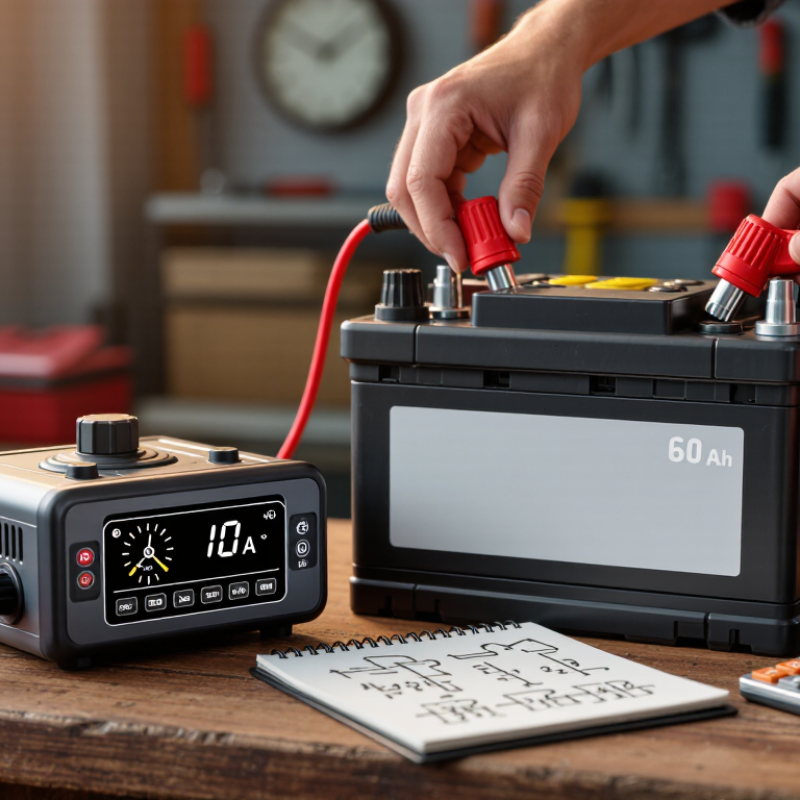
A battery can look ready on paper yet still need hours beside a charger. Learning how to estimate that time helps you plan trips, work shifts, and backup power without guessing. The How to calculate battery charging time formula starts with capacity in amp-hours divided by charging current in amps. A 60 Ah battery charged at 10 A suggests about six hours under ideal conditions. Real charging takes longer. Energy losses, temperature, battery age, and the charger’s output all affect the result.

Battery expert Isidor Buchmann’s Battery University guidance can be paraphrased this way: charging time is an estimate shaped by the battery and charger, not a guaranteed countdown. That distinction matters. A charger may reduce current near full charge, while a cold battery may accept energy more slowly. Seven practical tips can help you make a better estimate: check the battery label, confirm charger current, account for charging losses, consider the battery’s chemistry, watch temperature, allow for the final charging stage, and verify the result with the manufacturer’s guidance. Look at the numbers closely. A charger marked “10 A” may not deliver that current throughout the session. The formula is useful, but it is not perfect. Treat it as a planning tool, then leave a little extra time.
How to Calculate Battery Charging Time 7 Tips

Understanding the Battery and Charger Specifications

Before estimating charging time, identify the battery’s chemistry, rated voltage, and capacity. Capacity is usually printed in amp-hours (Ah) or milliamp-hours (mAh). A 5,000 mAh battery holds 5 Ah; divide by 1,000 to convert. Check the units.

Voltage matters because the charger must match the battery’s requirements, not merely fit its connector. A charger label may list output voltage and current, such as 5 V and 2 A. The current rating describes its maximum output, but the battery may not accept that full amount throughout charging.

For a rough estimate, divide the battery’s capacity in amp-hours by the charger’s output current in amps. A 4 Ah battery supplied at 2 A gives a simple estimate of two hours. Real charging usually takes longer because of energy losses and slower charging near full capacity.

Battery age, temperature, and the device’s charging controls can also affect the result. Check the manual or label for a recommended charging rate, especially when specifications are unclear.

This calculation is only a starting point; I would not treat it as a promise. That distinction is easy to overlook.

A charger’s advertised maximum current does not guarantee the battery will draw it.

Calculating Charging Time with a Basic Formula

A basic estimate is charging time in hours = battery capacity in amp-hours ÷ charging current in amps. For example, a 60 Ah battery charged at 10 A takes about six hours under ideal conditions. A useful starting point. Real charging is less tidy: some energy is lost as heat, and the charger may not deliver its full rated current throughout the cycle. If you allow for roughly 80 percent efficiency, the estimate becomes about 7.5 hours. Treat that figure as a guide, not a promise.

The battery’s starting charge matters, too. If a 60 Ah battery is half full, roughly 30 Ah needs replacing, so the same 10 A charger suggests about three ideal hours, or longer in practice. Near full charge, many batteries accept less current. That final stretch can surprise people. Check that the charger’s output matches the battery’s permitted charging range, and use the battery maker’s guidance for its actual limits. Capacity labels, temperature, age, and charging circuitry can all change the result. The simple formula is useful for planning, but it can be stubbornly optimistic. A clock and a charging indicator may tell different stories.

How to Calculate Battery Charging Time

Estimated charging time for different battery capacities using a 20 W charger and an assumed charging efficiency of 85%.

Basic formula: Charging time (hours) = battery capacity (Wh) ÷ charger power (W) ÷ charging efficiency. These estimates do not account for slower charging near full capacity.

Adjusting the Estimate for Charging Efficiency

Charging-time estimates look precise, but real batteries rarely behave like simple containers. Use this formula: hours ≈ capacity × state-of-charge increase ÷ charger power ÷ charging efficiency. For a 60 kWh battery rising from 20% to 80%, about 36 kWh must be stored. A steady 7 kW charger gives an ideal time of 5.1 hours; at 90% efficiency, the estimate becomes roughly 5.7 hours. This assumes full charger output throughout, which may not happen.

The National Renewable Energy Laboratory’s 2024 Annual Technology Baseline uses 85% round-trip efficiency for utility-scale lithium-ion storage. That figure covers energy going into and back out of a system; it is not a universal charging-only efficiency. Charging losses vary with temperature, power electronics, battery chemistry, and battery-management settings. Near full charge, power often tapers. A chilly garage can also slow charging. The estimate may still be imperfect.

Tip: Compare energy drawn at the wall with the battery’s change in stored energy over several ordinary charging sessions. Keep the charger, temperature, and starting charge similar. Use your measured efficiency in the formula, rather than borrowing a round-trip figure. Small test. Better estimate.

Seven Tips for More Accurate Charging-Time Estimates

Estimate charging time with seven practical checks. Tip 1: Use the battery’s usable capacity, not just its advertised capacity. Tip 2: Check the charger’s actual output in watts; its maximum rating may not match typical output. A basic estimate is battery energy in watt-hours divided by charging power. Start with the basics. That gives an ideal time, not a promise.

Tip 3: Account for the starting charge. A battery at 40 percent usually needs less time than one near empty.
Tip 4: Allow for charging losses, which turn some energy into heat.
Tip 5: Expect slower charging near full capacity, as many systems reduce power to protect the battery. Small details matter. Temperature, battery age, and device settings can also change the result.

Tip 6: Check reliable specifications for both the battery and charger, and use compatible equipment. Tip 7: Compare your estimate with a few real charging sessions. For example, a 500-watt-hour battery charged at an effective 100 watts needs five hours in an ideal calculation. In practice, tapering and losses can add time. I would treat any single estimate as a useful starting point, not a precise forecast. Keep notes on charge level, room temperature, and elapsed time; the pattern may be more useful than one perfect-looking calculation.

Checking Charging Progress and Battery Safety

A charging-time estimate is only a starting point. Check the battery percentage when charging begins, then again after 30 minutes. If it rises by 20 points, a simple projection suggests roughly two and a half hours for a full charge. Real charging rarely follows that pace. The display may update slowly, and many batteries charge more gently near full. I used to trust the first estimate too much; it was often off by a noticeable amount. Small changes matter.

Watch for heat, unusual smells, swelling, or a damaged cable. Stop charging and seek qualified advice if you notice these signs. Keep the device on a firm, uncovered surface, away from bedding and direct sunlight. Use a charger and cable recommended for the device, and check the manufacturer’s instructions for temperature limits.

Warm can be normal. Hot is different. Do not handle a swollen battery or try to open it. A charging indicator can show progress, but it cannot confirm that a battery is safe. I still forget to check the cable before plugging it in, which is a habit worth correcting. My estimate is useful, but the battery’s condition matters more.

FAQS

How can I estimate charging time for an amp-hour battery?

Divide capacity in amp-hours by charging current in amps. A 60 Ah battery charged at 10 A takes about six ideal hours. Real charging takes longer.

How does the battery’s starting charge affect charging time?

A half-full 60 Ah battery needs about 30 Ah restored. At 10 A, that suggests three ideal hours, before losses and slower charging near full.

How do I estimate charging time using kilowatt-hours?

Multiply battery capacity by the increase in charge level, then divide by charger power and efficiency. A 60 kWh battery rising from 20% to 80% needs about 36 kWh.

How does efficiency change that estimate?

At 7 kW, 36 kWh takes about 5.1 hours ideally. At 90% efficiency, the estimate is roughly 5.7 hours. That number can still be wrong.

Why might charging slow near full?

Many batteries accept less current as they approach full charge. A 10 A charger may not deliver 10 A throughout the session. The last stretch can surprise you.

Is 85% round-trip efficiency a universal charging figure?

No. It describes energy going into and back out of a storage system, not charging alone. Chemistry, temperature, and battery controls affect losses.

How can I make a more reliable estimate at home?

Compare energy drawn from the wall with the battery’s stored-energy increase over several similar sessions. Keep the starting charge, charger, and temperature alike. Small test. Better estimate.

What should I check before charging?

Make sure the charger’s output fits the battery’s permitted range. Age, temperature, and capacity labels can affect timing. The clock and indicator may disagree.

Conclusion

To estimate battery charging time, first check the battery’s capacity and the charger’s output, making sure their units are compatible. The basic calculation is charging time = battery capacity ÷ charging current. For example, a higher charging current generally means a shorter estimate, but the result is only a starting point. The phrase “How to calculate battery charging time formula” refers to this simple method and the adjustments needed to make it more realistic.

Charging is not perfectly efficient, and current may decrease as a battery approaches full capacity. To improve your estimate, account for charging efficiency, confirm the charger’s actual output, consider the battery’s existing charge level, and allow extra time for temperature or device-related limits. Check progress periodically rather than relying only on a calculation. Use a compatible charger, follow the battery’s instructions, and stop charging if you notice unusual heat, swelling, or damage. These steps help produce a more accurate estimate while supporting safe charging.

Madeline

Madeline

Madeline is a dedicated marketing professional with a wealth of expertise in our company's core offerings. With a keen understanding of the industry, she brings a unique perspective to her role, consistently delivering high-quality content that highlights the superior aspects of our products. As......