When considering battery maintenance, understanding charging parameters is crucial. One common question arises: "What is the best charging current for a 100Ah battery?" Experts in the field provide valuable insights. According to Dr. Emily Carter, a leading battery technology researcher, “Charging a 100Ah battery efficiently depends on various factors, including battery type and usage.”
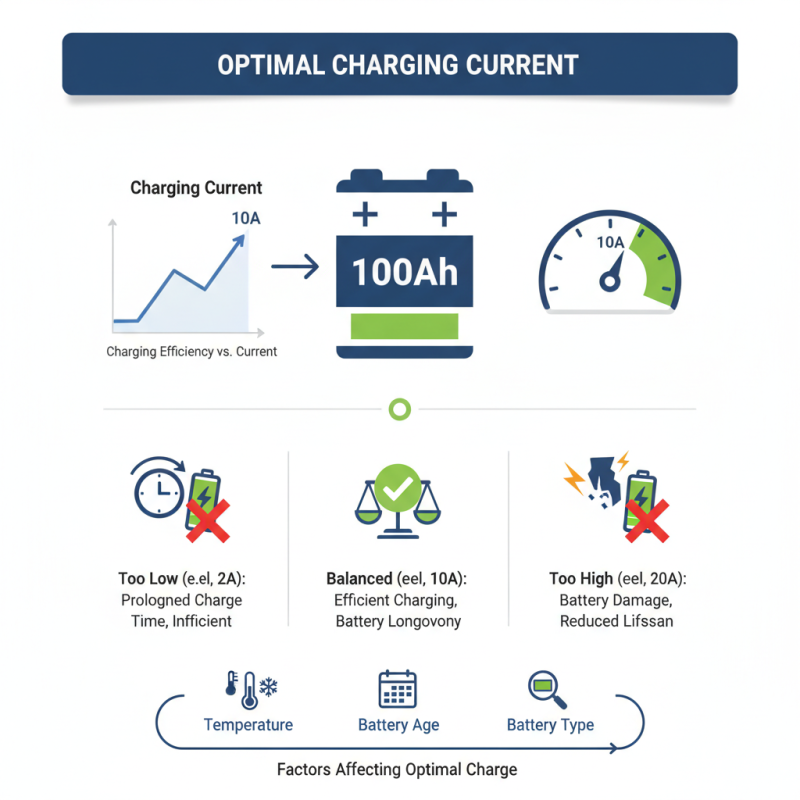
Finding the optimal charging current can enhance battery life. Too low a current could prolong charging time, while too high a current may cause damage. Many suggest a charging rate of 10A for a balanced approach. This rate ensures efficient charging without overwhelming the battery. Yet, individual battery specifications often vary.
Experiments show that the ideal charging current fosters greater longevity. Battery owners should not overlook these nuances. Properly assessing specific battery requirements is essential. Factors like temperature and battery age also play significant roles. Regularly monitoring these aspects can lead to better charging practices. Understanding the best practices for charging is an ongoing learning process.
Understanding battery capacity and charging fundamentals is vital for effective battery management. A
100Ah battery indicates its capacity to deliver one amp of current for 100 hours, or 100 amps for one hour. Nonetheless, the charging current must be carefully calculated to prevent damage. Industry standards suggest a charging rate of 0.1C to 0.3C. For a 100Ah battery, this translates to a safe charging range of 10 to 30 amps.
Charging a battery too quickly can create heat and stress, reducing its lifespan. Data from the Battery University emphasizes that charging at 0.2C is often optimal for longevity and efficiency. However, voltage and temperature also influence charging. Higher temperatures can accelerate chemical reactions, while lower temperatures can reduce efficiency. Hence, testing multiple variables is crucial.
In practice, not every battery performs identically. Variations in age, usage, and manufacturer specs can all affect outcomes. Regular monitoring of the battery’s performance can highlight inefficiencies. This helps adapt charging strategies based on real-time data. The pursuit of balance in charging—neither too fast nor too slow—ensures the battery remains reliable over time. It’s an ongoing process that requires adjustments and reflections on past practices.
When determining the optimal charging current for a 100Ah battery, several factors come into play. One key consideration is battery chemistry. Different types, such as lead-acid, lithium-ion, or nickel-metal hydride, require distinct charging profiles. For instance, lead-acid batteries typically charge safely at a rate up to 0.5C, while lithium batteries can often handle faster rates. This difference significantly influences the current settings.
Temperature also impacts charging efficiency. Batteries perform optimally in specific temperature ranges. Extreme heat or cold can lead to reduced performance and even damage. A battery charged in colder conditions might require adjustments to prevent undercharging. Conversely, high temperatures can increase charging speed but may lead to shortened battery life if not managed properly.
Moreover, aging and battery state affect the charging current. An older battery may struggle to accept high currents effectively. Keeping track of a battery's health through regular maintenance is vital. Over time, misconceptions about "always using maximum current" can lead to inefficient charging practices. Therefore, knowing your battery's condition and adjusting accordingly remains essential for longevity and performance.
Determining the right charging current for a 100Ah battery is crucial for maximizing its lifespan and performance. The commonly recommended charging current is about 10% of the battery's capacity. This means setting the charge rate to 10A is often ideal. However, environmental factors can influence this choice. High temperatures may require a lower current to prevent overheating. Meanwhile, colder conditions sometimes call for slightly higher rates to ensure proper charging.
Many users overlook the importance of initial charging settings. If the current is too high, it can lead to faster degradation of the battery. On the other hand, charging at a rate that is too low may result in incomplete charging cycles. Regularly monitoring battery voltage and temperature during charging can provide essential data for users. Relying solely on automatic chargers without understanding the battery's requirements can lead to mistakes.
Proper charging practices can extend battery life. However, some individuals may not consider the specific demands of their battery type and usage conditions. Evaluating personal charging habits can reveal areas for improvement. Adjusting the charging current based on actual needs rather than default settings is a necessary step. Making small changes often leads to significant long-term benefits.
Charging a 100Ah battery correctly can significantly extend its lifespan. Proper maintenance begins with understanding the optimal charging current. Generally, a charge rate of 10A is recommended. This number represents around 0.1C, ensuring a safe and effective charge. Charging too quickly can generate excess heat. This heat can degrade the battery's chemistry and reduce its overall life.
Regular monitoring is equally crucial. Keep an eye on battery temperature during charging. If it exceeds safe limits, consider adjusting your charge rate. Using a smart charger can help maintain the right current automatically. Additionally, it’s important to avoid letting your battery undergo deep discharges frequently. This practice can lead to irreversible damage over time.
Watering is another detail many overlook. For flooded lead-acid batteries, maintaining the electrolyte level is essential. Low electrolyte can harm the battery plates. Check the levels regularly and top up with distilled water as needed. Keeping connections clean and tight also prevents resistance that can affect charging performance. Engaging in these best practices ensures longer battery life and reliable performance.
| Charging Method | Optimal Current (A) | Charging Time (Hours) | Battery Condition |
|---|---|---|---|
| Constant Current | 20A | 5-6 Hours | Healthy |
| Trickle Charging | 5A | 20-24 Hours | Maintaining Charge |
| Fast Charging | 50A | 2-3 Hours | New/Good Condition |
| Float Charging | 1A | Continuous | Long-Term Storage |
Charging a 100Ah battery safely is essential for its longevity and performance. During charging, it's crucial to monitor the temperature closely. A battery that overheats may experience thermal runaway, leading to damage or failure. Keep the charging environment well-ventilated. Adequate airflow helps dissipate heat generated during the process.
Overcharging is another significant concern. It can degrade the battery’s lifespan dramatically. Set the charger to the recommended voltage and current levels. Many sources suggest a charging rate between 10A to 20A for a 100Ah battery. This range balances efficiency and safety. Regularly check the voltage with a multimeter to ensure it stays within safe limits.
Additionally, using chargers with built-in safety features can minimize risk. Automatic shut-off functions, voltage regulation, and temperature monitoring are vital. These features protect the battery from issues that may arise during charging. Always adhere to manufacturer guidelines. They provide insights tailored for specific battery types. Neglecting these details can lead to critical mistakes.
h battery rating mean?
Industry standards suggest a charging rate of 0.1C to 0.3C, which is 10 to 30 amps for a 100Ah battery.
Charging too quickly generates heat, which can stress the battery and shorten its lifespan.
Higher temperatures may speed up chemical reactions, while lower temperatures can reduce charging efficiency.
Regular checks help identify inefficiencies and allow adjustments to charging strategies based on real-time data.
Charging at 0.2C is often optimal for enhancing battery longevity and overall efficiency.
Avoid frequent deep discharges; they can cause irreversible damage to the battery over time.
Low electrolyte can harm battery plates in flooded lead-acid batteries, so top up with distilled water regularly.
Monitor battery temperature during charging; adjust the charge rate if it exceeds safe limits.
Using a smart charger can help maintain the right current automatically. Regular maintenance is essential.
In the exploration of battery charging, understanding battery capacity and the fundamentals of charging is crucial. When considering what is the best charging current for a 100Ah battery, it's important to recognize the factors that influence optimal charging, including temperature, battery health, and the type of charger used. Typically, a charging current of 10-20% of the battery’s capacity, or 10A to 20A for a 100Ah battery, is recommended to ensure efficiency without risking damage.
Adopting best practices for charging is essential in prolonging battery life. This includes avoiding deep discharges and maintaining the battery in a controlled environment. Additionally, safety during the charging process is paramount; always adhere to safety guidelines to prevent hazards. By following these recommendations, users can effectively ensure their 100Ah batteries are charged in the most optimal and safe manner.

Hyper Charger