How to Safely Charge Batteries in Series vs Parallel?

Time:2026-09-15 Author:Sophia
0%

How to safely charge batteries in series vs parallel begins with one basic fact: battery connections change charging behavior. In a series pack, voltages add together, but the same current flows through every cell. In a parallel pack, voltage stays similar, while available capacity and current capability increase. These differences affect charger selection, wiring, monitoring, and failure risks.

Battery safety educator Isidor Buchmann, founder of Cadex Electronics, states, “The charger must match the battery chemistry.” That principle remains essential. A lithium-ion pack needs a compatible constant-current and constant-voltage charger. A lead-acid bank requires a different charging profile. Using the wrong charger can cause overheating, swelling, leakage, or permanent damage. Never guess.

For series batteries, use a charger designed for the complete pack voltage. A 24-volt system does not safely accept a 12-volt charger. Each battery should have similar chemistry, capacity, age, and state of charge. A balancing system or battery management system adds important protection. Watch for uneven temperatures and voltage differences.

Parallel charging also requires matched batteries and secure connections. Loose terminals can create resistance, heat, or uneven current sharing. Use correctly sized cables, suitable fuses, and a charger rated for the bank’s voltage and capacity. Keep batteries on a nonflammable surface. Check them while charging.

Small details matter.

This guide explains practical testing steps, charger choices, and common mistakes. It also acknowledges an uncomfortable truth: even careful procedures cannot eliminate every failure. Manufacturer instructions should always override general advice.
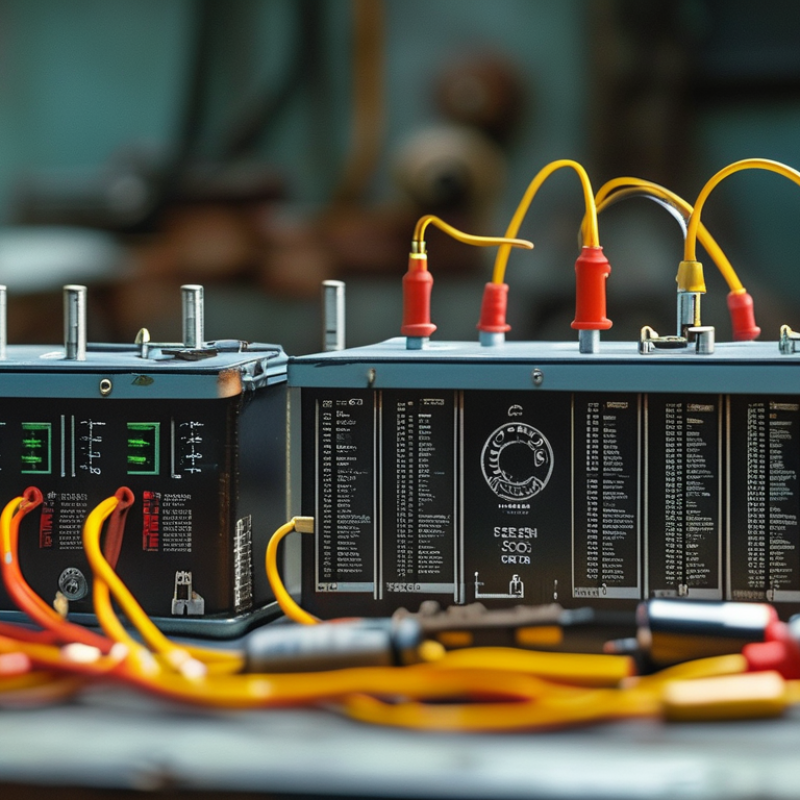
How to Safely Charge Batteries in Series vs Parallel?

Battery Series vs Parallel: Key Differences in Voltage and Capacity

Battery connections change two essentials: voltage and capacity. In a series pack, battery voltages add together. A pair of 12-volt batteries produces about 24 volts, while amp-hour capacity stays the same. This higher voltage can reduce current in some systems. However, one weak battery can limit the entire pack. The pack is only as balanced as its weakest unit.

Parallel connections work differently. Voltage remains at the level of one battery. Amp-hour capacity increases, so two 12-volt, 50Ah batteries can provide roughly 100Ah. More stored capacity sounds simple. It is not always simple.

Batteries should have matching chemistry, voltage, age, and condition. Otherwise, the stronger battery may push current into the weaker one. Heat, uneven charging, and premature wear can follow.

Charging a series pack requires a charger rated for the total series voltage. A balancing system is strongly recommended, especially for rechargeable cells with separate voltage limits. For parallel packs, use a charger that matches the shared voltage and the required current. Check cables, connectors, and protective devices before charging. Keep the batteries on a stable, nonflammable surface. Stop if you notice swelling, unusual heat, leaking, or a sharp chemical smell. I have found that voltage readings alone can create false confidence. Measure each battery separately, not only the complete pack. Small differences often reveal a problem before charging makes it worse.

Essential Safety Checks Before Connecting Batteries

How to Safely Charge Batteries in Series vs Parallel?

Before connecting batteries, confirm identical chemistry, nominal voltage, capacity, age, and model history. A series connection increases voltage, while a parallel connection increases available capacity and current. Neither arrangement is automatically safer. The charger must match the total voltage and charging profile. Check polarity twice. Then check it again.

Inspect every battery for swelling, cracks, corrosion, leakage, or unusual warmth. Do not connect damaged units. Measure each battery separately with a calibrated meter, because a similar reading can hide internal imbalance. A battery management system helps, but it does not replace inspection.

The uncomfortable part is this: visual checks can miss early failure. Allow batteries to rest, then compare their voltages before connection. For parallel banks, use equal-length cables and individual branch protection. For series banks, confirm that balancing equipment supports the full configuration.

The National Fire Protection Association’s Home Structure Fires report found electrical distribution and lighting equipment involved in 24% of home fires during 2016–2020. Batteries are not the only cause, but poor electrical control remains a serious warning. The International Energy Agency reported nearly 14 million electric car sales in 2023, increasing the need for trained handling.

Charge on a nonflammable surface, maintain ventilation, and monitor temperature during the first cycle. Stop immediately if heat, odor, noise, or swelling appears. Never leave an unfamiliar battery setup unattended. More testing would have been wiser.

Step-by-Step Guide to Charging Batteries in Series

How to Safely Charge Batteries in Series vs Parallel?

Charging batteries in series requires careful voltage control. Each battery adds voltage to the pack, while the capacity usually remains similar. Check the battery labels and technical documents before connecting anything. Use batteries with the same chemistry, capacity, age, and charge condition. A mixed set can charge unevenly and create dangerous heat.

Connect the batteries in sequence, with the positive terminal of one battery linked to the negative terminal of the next. The charger’s output voltage must match the total series voltage. Its charging current must stay within the manufacturer’s recommended range. A suitable battery management system can monitor individual cells and balance them during charging. Do not rely only on the charger’s display. Measure the pack carefully with a verified meter, and confirm polarity before switching on. Stop immediately if you notice swelling, leaking, unusual odor, or rapid heating.

Tips: Place the pack on a nonflammable surface with clear airflow. Stay nearby during charging. Check connections for looseness or corrosion. Never connect batteries with different chemistries. In practice, even careful technicians can miss a small voltage difference, so recheck every battery before and after charging. Keep children and flammable materials away. If one battery repeatedly reaches a higher voltage, disconnect the pack and have the system inspected. A parallel arrangement needs different current calculations, so do not use series-charging instructions for it.

Step-by-Step Guide to Charging Batteries in Parallel

Charging batteries in parallel increases capacity while keeping voltage unchanged. The setup can work safely, but only with compatible batteries. Use the same chemistry, nominal voltage, capacity, and similar age. For lithium batteries, confirm that parallel operation is permitted by the battery manufacturer and that every pack has a functioning battery management system.

Disconnect all batteries before inspection. Measure each battery at rest. Their voltages should be closely matched; a large difference can create a sudden equalizing current. Connect positive terminals together, then negative terminals together. Use cables of equal length and gauge, and place an individual fuse near each positive terminal. The charger must match the bank’s chemistry and voltage. Its current rating should suit the combined capacity, not just one battery.

Charge slowly at first. Watch for heat, swelling, unusual odor, or voltage imbalance. Stop immediately if any appears. Do not charge damaged batteries.

The National Fire Protection Association estimated about 24,200 U.S. home fires annually from electrical distribution and lighting equipment during 2016–2020. That figure is not limited to batteries, but it shows why small wiring faults deserve attention. A 2024 energy-storage safety report also highlights thermal runaway as a key hazard in lithium-based systems. My practical mistake would be trusting identical labels too quickly; internal resistance can still differ. Check again after charging. Never leave a newly assembled parallel bank unattended.

How to Safely Charge Batteries in Series vs Parallel? - Step-by-Step Guide to Charging Batteries in Parallel

Comparison Dimension Charging Batteries in Series Charging Batteries in Parallel Safe Practice and Verification
Electrical connection The positive terminal of one battery is connected to the negative terminal of the next battery. All positive terminals are connected together, and all negative terminals are connected together. Inspect the wiring diagram before connecting the charger. A wrong connection can cause a short circuit, excessive current, or equipment damage.
Total voltage Battery voltages add. Two 12 V batteries form a 24 V battery bank; three form a 36 V bank. The voltage remains approximately the same as one battery. Two 12 V batteries remain a 12 V bank. Use a charger whose output voltage matches the complete bank configuration and the battery chemistry.
Total capacity Ampere-hour capacity remains approximately the same as one battery. Two 12 V, 100 Ah batteries produce about 24 V, 100 Ah, or 2,400 Wh nominal energy. Ampere-hour capacity adds. Two 12 V, 100 Ah batteries produce about 12 V, 200 Ah, or 2,400 Wh nominal energy. Nominal watt-hours are calculated as voltage multiplied by ampere-hours. Usable energy is lower and depends on chemistry, temperature, age, and the permitted depth of discharge.
Required charger voltage The charger must be designed for the sum of the battery voltages. A 24 V bank requires a suitable 24 V charging profile, not a standard 12 V charger. The charger must be designed for the voltage of one battery. A 12 V parallel bank requires a suitable 12 V charging profile. Never increase charger voltage to compensate for a parallel connection. Excess voltage can overcharge the batteries.
Current sharing The same current flows through every battery in the series string. A weak or mismatched battery can limit the entire string. The total charging current is divided between the batteries, but the division may not be equal because of differences in resistance, cable length, state of charge, and temperature. Use equal-length, equal-gauge cables where practical, and connect the charger or load using balanced takeoff points.
Battery matching Use batteries with the same chemistry, nominal voltage, capacity, age, and condition. Mixing partially charged and fully charged batteries is unsafe. Use batteries with the same chemistry, nominal voltage, capacity, age, and condition. Do not directly parallel batteries with different voltages. Before connection, measure open-circuit voltage and investigate any significant difference. Do not use a damaged, swollen, leaking, hot, or physically deformed battery.
Balancing requirement More important because individual battery voltages can diverge even when total bank voltage appears normal. Cells or batteries can still drift in state of charge, although the shared bus tends to equalize voltage. Equalization current can be dangerously high if batteries are connected at different voltages. Use an appropriate battery-management system or balancing method required by the battery manufacturer, especially for lithium-based batteries.
Charger type Use a charger specifically rated for the complete series voltage and battery chemistry. A multi-bank charger may be needed to monitor each battery separately. Use a charger rated for the common bank voltage and total capacity. The charger must support the battery chemistry and the required charging profile. Do not use a lead-acid charging profile for lithium batteries or a lithium profile for lead-acid batteries.
Recommended charging current The charger current is selected for the capacity of one battery in the series string, subject to the battery specification. For a 24 V, 100 Ah string, a 10 A charger is still a 10 A charger for each series battery. The charger current is selected for the total bank capacity. For two 12 V, 100 Ah batteries in parallel, a 20 A charger supplies approximately 10 A per battery only when sharing is balanced. Follow the battery specification first. If no specification is available, do not assume a safe current from voltage or capacity alone.
Step 1: Pre-charge inspection Check battery case condition, terminals, polarity, wiring, fuses, ventilation, and the series-link cables. Check battery case condition, terminals, polarity, parallel links, fuses, ventilation, and cable symmetry. Disconnect the charger before changing wiring. Wear suitable eye and hand protection and keep sparks and flames away from batteries that can release gas.
Step 2: Confirm battery condition Confirm that all batteries are the same type and have a similar state of charge before forming the series string. Confirm that all batteries have nearly the same voltage before connecting them in parallel. Do not connect a fully charged battery directly to a significantly discharged battery; the initial equalization current may exceed the cable, fuse, or battery rating.
Step 3: Make the connection Connect the batteries in series according to the wiring diagram, then connect the charger positive and negative to the designated bank terminals. Connect positive-to-positive and negative-to-negative using appropriately rated cables, fuses, and busbars where required. Verify polarity with a multimeter before plugging in the charger. A reverse-polarity connection can damage the charger and battery.
Step 4: Start charging Set the charger to the total bank voltage and the correct chemistry profile. Monitor total voltage and each battery voltage during charging. Set the charger to the bank voltage and correct chemistry profile. Monitor the total voltage, charging current, and individual battery temperatures. Start at a conservative current if the equipment allows it. Stop immediately if there is unusual heat, odor, swelling, smoke, noise, or rapid voltage rise.
Step 5: End-of-charge check Confirm that each battery reaches the expected voltage range without a large voltage difference from the others. Confirm that charging current tapers as expected and that no battery becomes noticeably hotter or shows a different voltage behavior. Allow the charger to complete its approved cycle. Do not bypass a battery-management system or force a battery past its specified voltage.
Main advantage Provides higher system voltage, which can reduce current and cable losses for the same power level. Provides greater ampere-hour capacity at the same system voltage and can support longer runtime. The best configuration depends on the equipment voltage, cable distance, required power, battery specifications, and available protection devices.
Main risk An imbalanced battery can be undercharged while another is overcharged. Total bank voltage alone may not reveal the problem. Unequal batteries or low-resistance wiring can cause uneven current sharing and high equalization current during connection. Use protection sized for the wiring and battery bank, including fuses or circuit breakers where appropriate. Never rely on the charger alone for short-circuit protection.
When not to charge Do not charge if any battery is damaged, frozen, leaking, swollen, excessively hot, or has a major voltage imbalance. Do not charge if batteries are mismatched, connected with damaged cables, or showing uncontrolled current sharing or abnormal temperature rise. Isolate the battery bank and obtain assessment from a qualified technician when the cause of abnormal behavior is unknown.
Safety note: Battery charging requirements vary by chemistry and model. Always follow the battery, charger, wiring, fuse, ventilation, and battery-management-system specifications. The examples above are nominal calculations and are not a substitute for the manufacturer’s charging limits.

Charger Selection, Monitoring, and Troubleshooting Safety Risks

Charging batteries in series raises voltage, while parallel wiring increases capacity and available current. The charger must match the pack’s total voltage, chemistry, and charging profile. A series pack also needs cell-level balancing. One weak cell can reach its limit before the others. In parallel, use batteries with matching age, capacity, and state of charge. Unequal packs may exchange large equalizing currents. That is not harmless.

A practical safety check includes voltage, temperature, connector condition, and charging current. Monitor every cell group, not only the pack terminals. Stop charging if a cell drifts, a connector becomes hot, or the battery swells. NFPA 855 and UL 9540A focus on thermal-runaway control and propagation testing. These standards show why enclosure design and monitoring matter. A voltage reading alone can mislead.

Use a constant-current/constant-voltage charger specified for the complete pack. Never substitute a charger because its plug fits. CPSC’s 2022 safety report recorded at least 208 fires or overheating incidents involving e-bikes and e-scooters, with 19 deaths, from January 2021 through November 2022. Charging was a recurring safety concern. Keep packs on a nonflammable surface, provide ventilation, and avoid overnight charging. My own caution is simple: troubleshooting often begins too late. If balancing repeatedly fails, replace the suspect pack rather than forcing another cycle.

FAQS

What changes when batteries are connected in series?

Voltage adds together, while amp-hour capacity stays unchanged. Two 12-volt batteries provide about 24 volts.

What changes when batteries are connected in parallel?

Voltage remains unchanged, but amp-hour capacity increases. Two 12-volt, 50Ah batteries provide roughly 100Ah.

Can any batteries be connected in parallel?

No. Use matching chemistry, voltage, capacity, age, and condition. Otherwise, uneven current flow may cause heat and early wear.

What charger does a series battery pack need?

Use a charger rated for the pack’s total voltage. A balancing system is strongly recommended for rechargeable cells.

What charger does a parallel battery pack need?

Choose a charger matching the shared voltage and battery chemistry. Its current rating should suit the combined capacity.

How should batteries be checked before parallel charging?

Disconnect every battery and measure its resting voltage separately. Large differences may create sudden equalizing current.

How should parallel batteries be wired?

Connect positive terminals together, then connect negative terminals together. Use equal-length cables and an individual fuse near each positive terminal.

What warning signs require immediate action?

Stop charging if batteries swell, leak, become unusually hot, or smell sharply chemical. Do not charge damaged batteries.

Is checking the complete battery pack enough?

No. Measure each battery individually. A complete-pack reading can hide one weak unit.

What practical mistake should users avoid?

Do not trust identical labels too quickly. Internal resistance may differ, so inspect the bank again after charging.

Conclusion

How to safely charge batteries in series vs parallel depends on understanding how each configuration affects voltage, capacity, and charging requirements. Batteries connected in series increase total voltage while maintaining the capacity of a single battery, whereas parallel connections increase capacity while keeping the voltage the same. Before making any connection, use batteries with matching chemistry, voltage, capacity, age, and charge level. Inspect terminals and cables for damage, confirm correct polarity, and work in a dry, well-ventilated area.

For series charging, use a charger designed for the complete series voltage and verify that each battery receives balanced charging. For parallel charging, ensure the batteries are evenly matched and connected with properly sized cables so current is distributed safely. Choose a charger with suitable voltage and current limits, monitor temperature and charging progress, and stop immediately if batteries swell, leak, overheat, or behave unusually. Regular inspection, protective equipment, and careful troubleshooting help reduce the risks of short circuits, overcharging, and uneven battery performance.

Sophia

Sophia

Sophia is a dedicated marketing professional with an exceptional depth of knowledge about her company's products and services. With a keen understanding of market trends and customer needs, she crafts insightful blog posts that not only inform but also engage readers, enriching the company’s online......